Forgetting My Own Lessons: Why My Comic Book Thumbnails Are Too Detailed

The Reality of Client Juggling
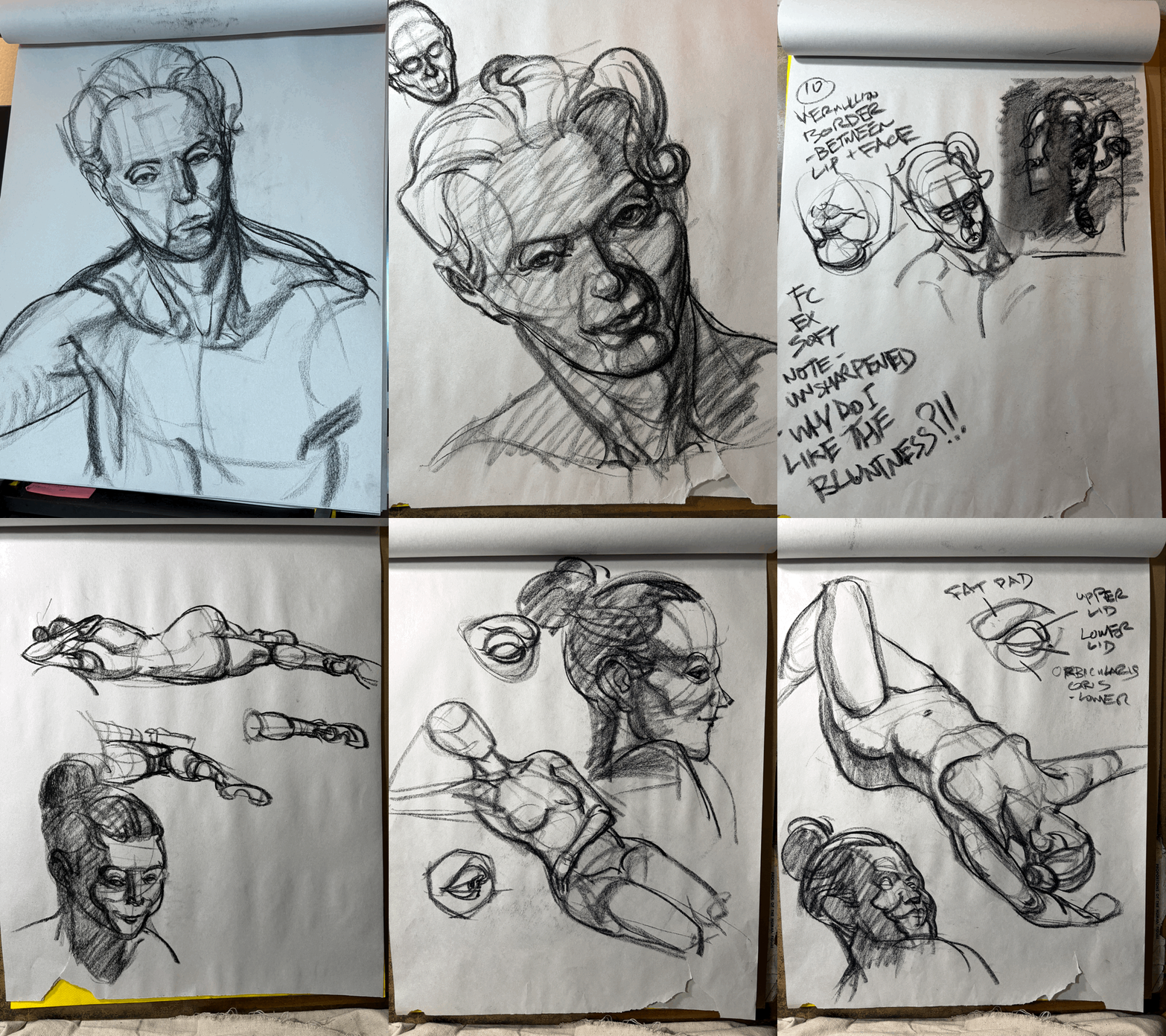
Due to work, I had to miss figure drawing class this week. That happens sometimes—things get busy with clients, and you gotta juggle priorities. But I did end up spending the evening, after I got everything wrapped up, doing some redrawing of less than successful figure drawings as I am wont to do.
Honestly, it feels like it’s been two weeks since I did any drawing because I spent like a week just being sick, and then this week just being busy and slammed with work. I don’t think that there’s anything in this batch of drawings I did that’s particularly successful or that good.
But it’s important, in the same way that it’s important to go outside and touch grass every day. Just moving forms around, moving shapes around, and playing with different proportions helps. Trying to see if something doesn’t work, I can ask: What else can I do? Is it a matter of adjusting the values or the proportions? Is something flat that should have depth, or does it have bumps where it shouldn’t be? Do I need to simplify? These are all questions that just getting back into the habit of drawing helps me formulate.
Bypassing Stiff Dialogue
On my reading list, I have dipped back into Jack Kirby’s The New Gods. A couple of issues into the collection, it started to feel like—while Kirby’s work itself is artwork and the visual storytelling is incredibly exciting—the dialogue and even the plot itself leave a little bit to be desired.
Part of that is true for a lot of writing from the 50s, 60s, and 70s. The New Gods was written in the 70s. For every luminary like an Alan Moore, a Roger Stern, or a Marv Wolfman, there are lots of comics where the writing feels a little bit stiff, rote, or just whatever is the simplest thing the character could say. Dialogue is not what Kirby is known for.
However, I found something that instantly made the book a lot more exciting to read: on my first pass, I started skipping and ignoring the word balloons entirely. I just read the page as a visual story, like a storyboard or a picture book. Then, whatever I didn’t understand from the visuals, I’d go back and skim the word balloons to get the context to fill it in.
By removing the weak suit, I was immediately excited again. It was like I was reading Kirby for the first time. It gave me the feeling of being a kid in the 70s who was just looking at the pictures and getting blown away by this amazing, surrealistic science fantasy world. It made me enjoy reading the book that much more.
Relearning Simplicity in Thumbnails
It also got me thinking about my own storytelling, my own writing, and how Kirby communicates so much. His backgrounds are actually extremely complex, but the essence of what the characters are doing is very streamlined and simplified with strong, powerful silhouettes.
Looking at the thumbnails for my Medusa comic, I realized my thumbnails are too detailed. The level of detail I’m putting in there—working out facial expressions and figuring out what details go where—is meant for the layout stage. Those are for when I’m fixing final anatomical and perspective details before I go to inks. For my thumbnails, I need to make myself draw simpler. I really just need to do stick figures and composition.
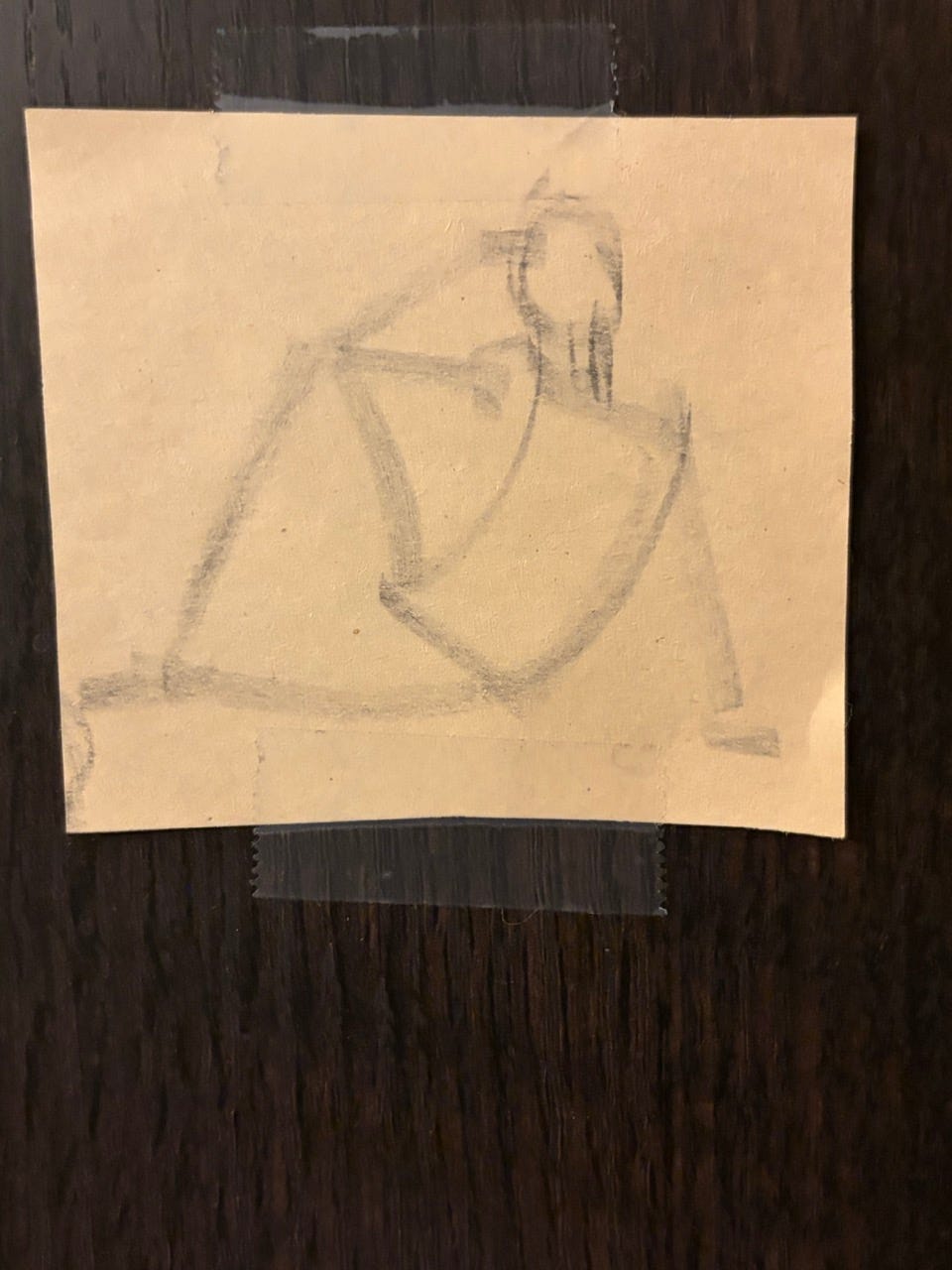
There is a small picture that I have taped to a cabinet in my office. It’s a simple stick figure laying on the floor with one knee up, resting their elbow on their knee. I taped that there as a reminder that when I’m doing a gesture drawing, this is what I’m trying to aim for: the simplest thing. It’s a curved rectangle with simple stick limbs and a head.
I keep that drawing there to look at as a reminder to myself, because I have forgotten my own lessons. I need to come back to that. The same simplicity I try to bring to gesture drawings, I need to bring to my comic book thumbnails. My layouts—which are basically my rough pencil stage—do need to be more detailed because I have to figure out the specific things I’m going to ink. But for the thumbnails, where I’m just breaking down panels, actions, and balloon placement, I need to go simpler. At least, I’m going to try to go simpler and see what happens.
Have you ever tried “silent reading” an old comic book just to focus on the art? Do you agree that older dialogue can sometimes make a classic story drag, or do you enjoy the vintage charm?
As creators, we often give great advice to others that we forget to follow ourselves. What is a fundamental rule of your craft that you recently realized you’ve been ignoring in your own work?
How do you separate your “thumbnail” stage from your “layout” stage? Do you struggle with putting too much detail into your initial rough sketches, or do you find it easy to stick to simple shapes and stick figures?